What the riding position does to your body
When you ride, your hips stay bent for hours and never fully open. The hip flexors stay short, the quads do most of the pedalling, and the glutes often do less than they could. The lower back holds your upper body over the bike, and the neck stays extended so you can see the road. Hands and forearms take weight on the bars, especially on rough roads.
Over a season this adds up: heavy, tight thighs, a stiff lower back after long rides, and tension between the shoulder blades and in the neck. If you also work at a desk, the position is almost the same as on the bike, so the body rarely gets the chance to open up.
How massage can help cyclists
- Quads and hip flexors — releasing the front of the hips and thighs, which carry most of the pedalling load
- Glutes and outer hips — helping them work properly, so the knees and lower back are under less strain
- Lower back — easing the stiffness from holding the same position for hours
- Neck, shoulders and chest — opening the front of the body and relaxing the upper back after the forward-leaning position
- Forearms and hands — useful after long rides or gravel and off-road riding
What a session looks like
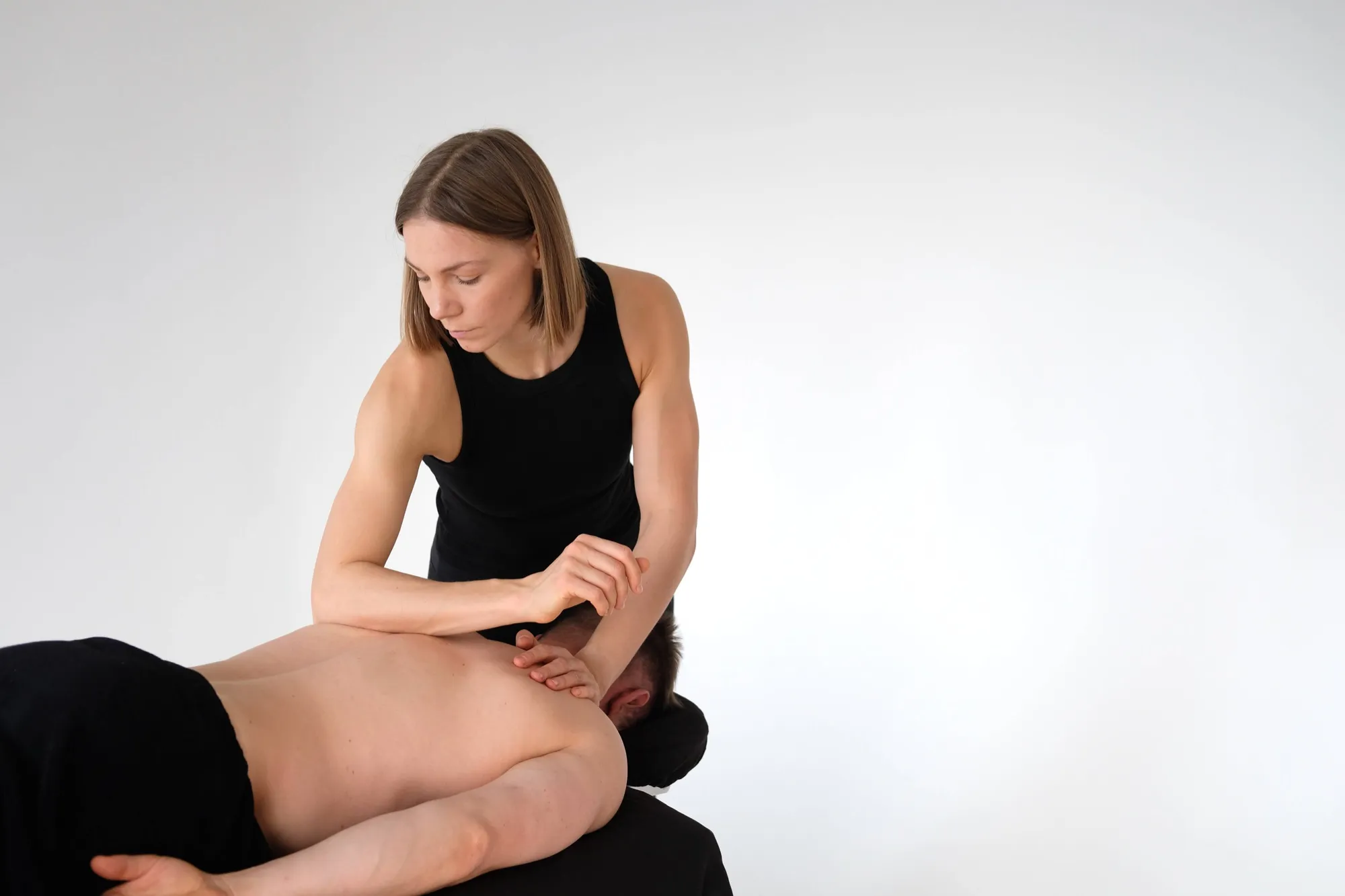
For most cyclists I use sport massage: deep tissue work, myofascial release, compressions and stretching, with cupping or trigger point work where it helps. I pay special attention to the front of the hips, because that area is easy to miss and often the source of lower back tightness.
If your upper body bothers you more than your legs, a Shoulders Mobility session focuses on the back, shoulder blades, chest, diaphragm, rotator cuff and neck. It is a good fit for cyclists with rounded shoulders.
A full-body session for a cyclist usually needs 90 minutes. In 60 minutes I focus on the legs and hips, or on the back and neck.
When to plan a massage
- After a long ride or a hard block — a day later is ideal
- Before an important event — the last deeper session several days before, not the day before
- In the off-season — a good time to work on long-standing stiffness and mobility
When to see a doctor first
Please see a doctor or physiotherapist before booking if you have:
- pain after a crash, especially with swelling, bruising or limited movement
- numbness or tingling in the hands, feet or groin that does not go away after riding
- knee pain that is sharp, swells or gets worse with every ride
- neck pain that spreads into the arm with weakness
Tell me about any past injuries when you book, so I can plan the session safely.