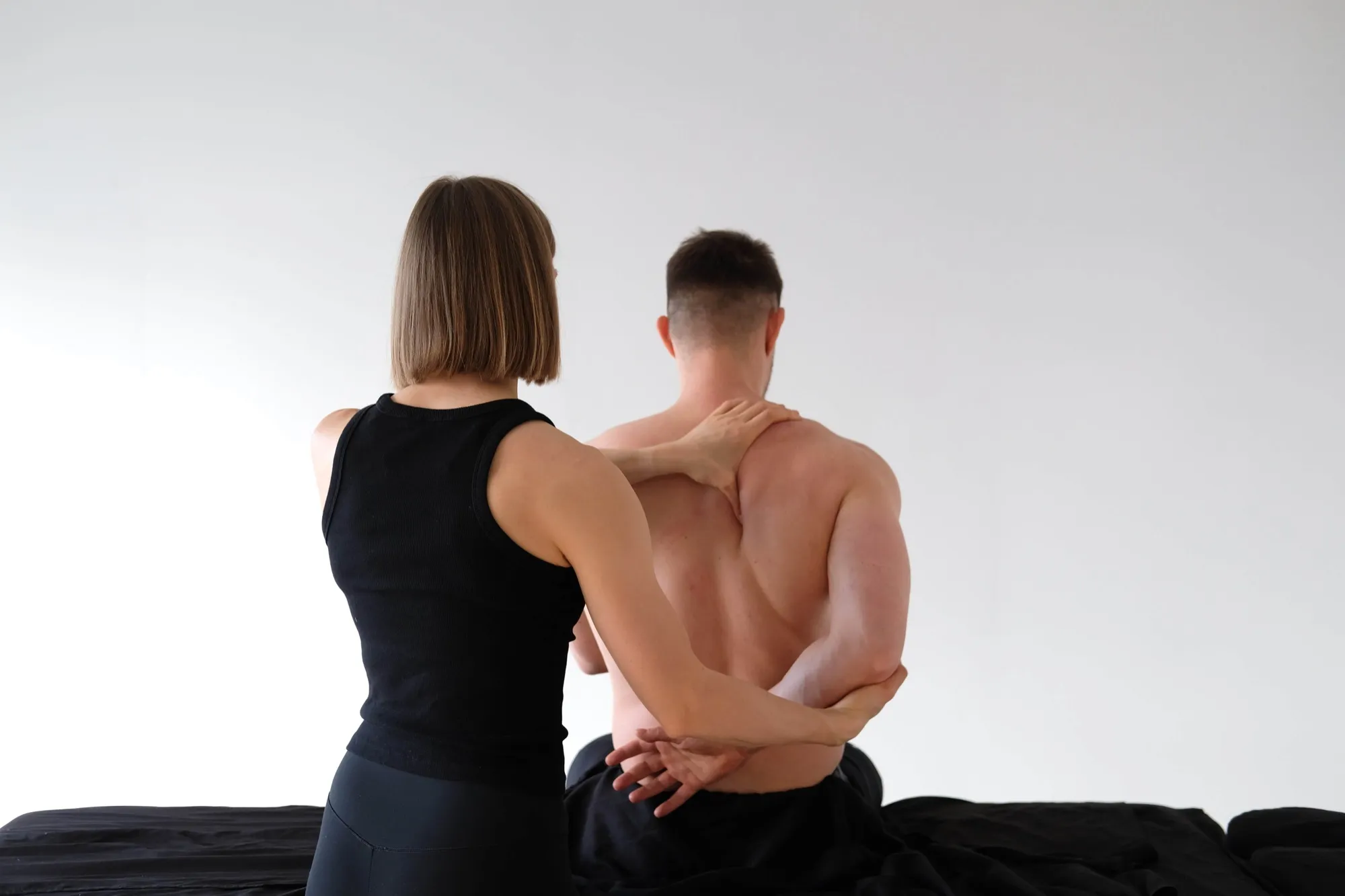
Why swimmers’ shoulders get tight
Every freestyle, backstroke or butterfly stroke takes the arm overhead and pulls the body through the water. The lats and chest muscles do the pulling, the rotator cuff keeps the shoulder joint stable, and the upper back holds the shoulder blades in place. Over thousands of strokes, these muscles get tired and short.
What I often see in swimmers is a tight chest and lats, which pull the shoulders forward, and a tired back of the shoulder that has to work hard to control the movement. Breathing to one side can make one side of the neck and upper back tighter than the other. If you also sit at a desk during the day, the rounded position adds to the same pattern.
How massage can help swimmers
- Lats and chest — releasing the big pulling muscles so the arm can reach overhead more freely
- Rotator cuff and back of the shoulder — easing the small stabilising muscles that work in every stroke
- Shoulder blades and upper back — helping them move and sit well on the ribcage
- Neck — especially on the side you breathe to
- Diaphragm and ribcage — the area between the ribs can stiffen too, and some swimmers find breathing feels freer afterwards
What a session looks like
For many swimmers the best fit is a Shoulders Mobility session. It is a focused hour on the back, shoulder blades, chest, diaphragm, rotator cuff and neck — the exact areas swimming loads the most.
If you want work on the legs and hips as well, I use sport massage: deep tissue work, myofascial release, stretching and, where it helps, cupping on the lats and upper back. The pressure is always adjusted to you, and I check in during the session.
How often
During regular training, once or twice a month helps many swimmers keep their shoulders comfortable. In heavier training blocks or before a competition season, more often is possible. The last deeper session before a race should be a few days earlier, not the day before.
When to see a doctor or physiotherapist first
Please get checked before booking if you have:
- sharp or pinching shoulder pain that is getting worse
- pain at night that wakes you up or stops you lying on that side
- a feeling that the shoulder slips, catches or gives way
- numbness, tingling or weakness in the arm or hand
- a recent fall or sudden pain during a stroke
If you are working with a physiotherapist, bring their advice, and I will plan the session around it.